
Studio Ayo
Back to Works
Live01 / 12
Case Study · FāëM

Faemous

Building a digital home for FāëM

FāëM is the musical project of brothers Demi and Fapelo. Their sound sits somewhere between African music and electronic music, combining their individual tastes into what they describe as Afro-Electronic fusion. The challenge was not simply to make them a website. It was to create a digital space that could hold the different sides of FāëM: the music, the people behind it, the visual world, live performances, releases, videos, press, community and future projects. So we built Faemous as a home for the FāëM universe.

One website. Many frequencies.

Project Details

2024 - 2026
Client / OrgFāëM
RoleProduct Designer / Web Designer / Developer
StatusLive
Scope
UXUIVisual DirectionResponsive Web DesignDevelopment
Tools
FigmaGoogle AntigravityVercel
Creative Team
Product Design & Creative EngineeringStudio Ayo
Artists & DirectionDemi & Fapelo (FāëM)
Original Motion Render
Project Narrative

The Story Behind the Work.

01

The Idea

Artists often end up with their identity scattered across platforms. Music lives on streaming services. Videos live somewhere else. Social media becomes the primary source of information. Press features disappear into timelines. Bookings happen through another channel.

Each platform serves its own purpose, but none of them necessarily communicates the complete identity of the artist.

FāëM needed a central place that could connect these pieces. The goal was therefore to make the website feel less like an information directory and more like an extension of the FāëM identity.

A visitor should be able to arrive without knowing the duo, understand who they are, experience their music and visual world, discover their projects, and find a way to continue the relationship.
02
Information Architecture

Designing an Artist's Universe

The website was structured around the different ways someone might interact with FāëM:

•Discover — Introduce the duo, their sound and their story.
•Listen — Surface releases and make it easy to move from the website into their music.
•Watch — Bring together music videos, visualizers and live performances.
•Experience — Give projects such as WAWDH? enough space to communicate their ideas and narrative.
•Follow — Connect visitors to FāëM’s social platforms and wider ecosystem.
•Support — Create space for merchandise, Bandcamp, SoundCloud and other ways to support the project.
•Work with them — Make bookings accessible without forcing visitors to hunt through social media.
03

The Homepage

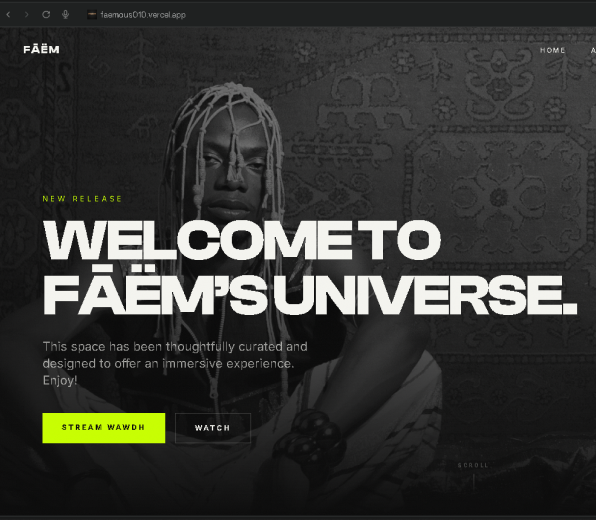
The homepage acts as the front door to the FāëM universe. Instead of beginning with a generic biography, the experience immediately establishes the current moment around the artist.

The current release, WAWDH?, becomes an important entry point, followed by the duo’s story, their sound, music releases, performances, videos, press and ways to support the project.

The result is a page that can function almost like an editorial spread. It tells visitors: This is who we are. This is what we’re making. This is what we’re thinking about. This is where you can experience it.

04

Giving the Music Room to Breathe

One of the more important decisions was not treating the music section as a simple list of streaming links. FāëM’s releases form part of their story, so the website gives projects context.

The current WAWDH? section, for example, introduces the project as a work conceptualised in 2024 and explains the ideas behind it, before directing visitors toward the music and accompanying visual material.

That distinction matters. Instead of "Album → Listen", the experience becomes "Idea → Context → Music → Visual experience". The website therefore works as both an artist archive and discovery experience.

05

WAWDH?

The WAWDH? project became one of the strongest opportunities for this approach. The project isn’t presented simply as a release; the website gives it room to explain what it means to the brothers.

The writing explores individuality, uncertainty, emotion, existence and the relationship between the individual and the larger universe. That gave the website a second job beyond navigation: it became a place where FāëM could explain the thinking behind the art.

The visitor isn’t only being asked to listen. They’re being invited into the thought process.

06

Beyond Music

FāëM’s identity extends beyond recorded tracks. The site therefore brings together music videos, visualizers, live sets, listening experiences, press features, social channels, community, merchandise, direct support, and bookings.

The current website includes videos such as Through Time, Messiah Complex and Wakabout, alongside live-set material and a collection of external press features.

This was important because a music artist’s website can very easily become a glorified streaming link. Faemous was designed to avoid that.

07

Visual Direction

The visual language was built around the character of FāëM rather than a conventional music-industry template. The brand describes its sound as: "Afro-Electronic fusion from Lagos. Dark, trippy, cinematic."

That description became useful as a north star for the experience. The interface needed enough restraint to let the photography, artwork, videos and music carry the emotional weight.

Rather than filling every section with decoration, the design uses the content itself as part of the visual system. The result is intended to feel cinematic, contemporary, slightly otherworldly and rooted in the artists’ identity.

08

Designing for an Evolving Artist

Another consideration was that the website couldn’t be treated as a static brochure. FāëM is an active music project: new releases will arrive, performances will change, videos will be added, press coverage will grow, merchandise may launch, and community channels will evolve.

The architecture therefore had to accommodate change. The current site already reflects this with sections for upcoming performances, releases, videos, press, shop and community.

Some areas are intentionally ready for future content rather than being artificially filled. For example, the Live section currently communicates that more shows are coming instead of manufacturing an experience around unavailable information. That sounds small, but it is an important product decision: the interface reflects the actual state of the artist.

09

From Figma to the Browser

I began the project by working through the experience in Figma, using wireframes to establish the structure before moving into the visual interface. From there, I translated the design into the working website.

For implementation, I used Google Antigravity as an AI-assisted development environment, using it to accelerate the transition from designed interface to functional web experience.

The final site was deployed through Vercel and eventually moved onto the project’s own domain: www.faemous010.com. The process allowed me to work across the boundary between design and development rather than treating implementation as something completely separate from the design process.

10

The Result

Faemous became a central digital home for FāëM. The live experience now brings the major parts of their ecosystem into one place: their story, current releases, discography, videos, live performances, press, community, support channels and bookings.

More importantly, the website gives those things a shared context. Instead of sending someone from Instagram to Spotify, from Spotify to YouTube, and from YouTube somewhere else, the website gives the visitor a place to begin and a reason to stay.

The website is not the music. It is the environment around it.

11

Faemous Today

The website is now live at www.faemous010.com. And as FāëM continues releasing music, performing, publishing visual work and building its community, Faemous has room to grow with them. One website. Many frequencies.

Execution Matrix

What I Worked On.

A multidisciplinary contribution spanning structural research, design systems, and frontend engineering.

01 / DISCIPLINE

UX / Structure

  • •Information architecture
  • •Content hierarchy
  • •Page and section structure
  • •User journeys
  • •Artist-content organisation
02 / DISCIPLINE

UI / Visual Design

  • •Interface design
  • •Typography & layout systems
  • •Responsive viewport behaviours
  • •Content presentation
  • •Visual hierarchy & pacing
03 / DISCIPLINE

Web Development

  • •Frontend implementation
  • •Responsive interactive layouts
  • •External platform integration
  • •Sub-second optimization & Vercel deployment
04 / DISCIPLINE

Creative Direction

  • •Translating FāëM identity into digital environment
  • •Balancing music, editorial content and visual media
  • •Designing experience around the artist rather than a generic template
Retrospective

What I Learned.

Key product insights, system learnings, and architectural principles distilled from the project.

01

A creative website does not need to behave like a conventional product website

For an artist, the website can simultaneously be an archive, a portfolio, a press kit, a storefront, a community hub, a storytelling device, and an invitation.

02

Knowing when each role should take the lead

For FāëM, the answer was not to build more pages. It was to create a system that allowed the different pieces of their identity to exist together without losing the personality that made them worth visiting.

03

The website is the environment around the music

Instead of scattering visitors across disconnected channels, Faemous establishes a cohesive digital world with room to grow.

Visual Archive

Selected Visual Assets

Gallery Asset 1
“The website instantly set our universe apart from every traditional record label. It looks, moves, and feels like high art.”
— FAËM (Demi & Fapelo) • Lagos Afro-Electronic Duo
Studio Ayo — Digital Web Design Studio · Lagos